The Viral Karpathy Claude.md File: Here’s the Honest Truth About What It Actually Is
Introduction
If you’ve spent any time in AI developer circles lately, you’ve almost certainly seen it shared. A GitHub repository called “Karpathy Claude Skills” — attributed to Andrej Karpathy, celebrated as a breakthrough, and currently sitting at over 90,000 stars and 6,000 forks.
The reactions range from “this changed my entire workflow” to “every AI developer needs this immediately.” The shares, reposts, and breathless threads keep coming.
So what is it, exactly?
It’s a single markdown file. 66 lines. No code. No framework. No automation. Four pieces of plain-English advice for how an AI coding agent should behave.
This post is the honest breakdown of what the file actually contains, why the hype deserves scrutiny, and how to use it properly — without overstating what it can and cannot do.
What the Claude.md File Actually Contains
The repository, created by GitHub user Forest Chain, contains one file: claude.md. It’s designed to be read by Claude Code at the start of a session as a behavioral instruction layer.
The four principles inside are:
Principle 1: Think Before Coding
The agent should not silently guess at your intent. If something is ambiguous, it should surface the ambiguity, state its assumptions explicitly, and ask before proceeding. No charging ahead based on guesswork.
Principle 2: Simplicity First
Write the minimum code that solves the problem. No speculative abstractions. No unsolicited flexibility or configurability. No over-engineering. The file is direct about it: if you write 200 lines and it could be 50, rewrite it.
Principle 3: Surgical Changes
Touch only what you must. Don’t improve adjacent code. Don’t refactor things that aren’t broken. Match existing style even if you’d personally do it differently. Every changed line should trace directly back to the user’s request.
Principle 4: Goal-Driven Execution
Transform tasks into verifiable goals. “Fix the bug” becomes “write a test that reproduces the bug, then make it pass.” Define success criteria upfront and loop until verified.
These are good principles. Solid, actionable, and well-articulated. The heuristic — “would a senior engineer say this is overcomplicated? If yes, simplify” — is genuinely useful.
Five Reasons the Hype Deserves Pushback
1. It’s Not Karpathy’s File
The repository is explicitly described as derived from Andrej Karpathy’s observations about LLM coding behavior. Karpathy did not write it, did not publish it, and as far as publicly available information shows, did not endorse it. Attaching his name to the repo is a marketing decision — and a spectacularly effective one. That’s worth being honest about.
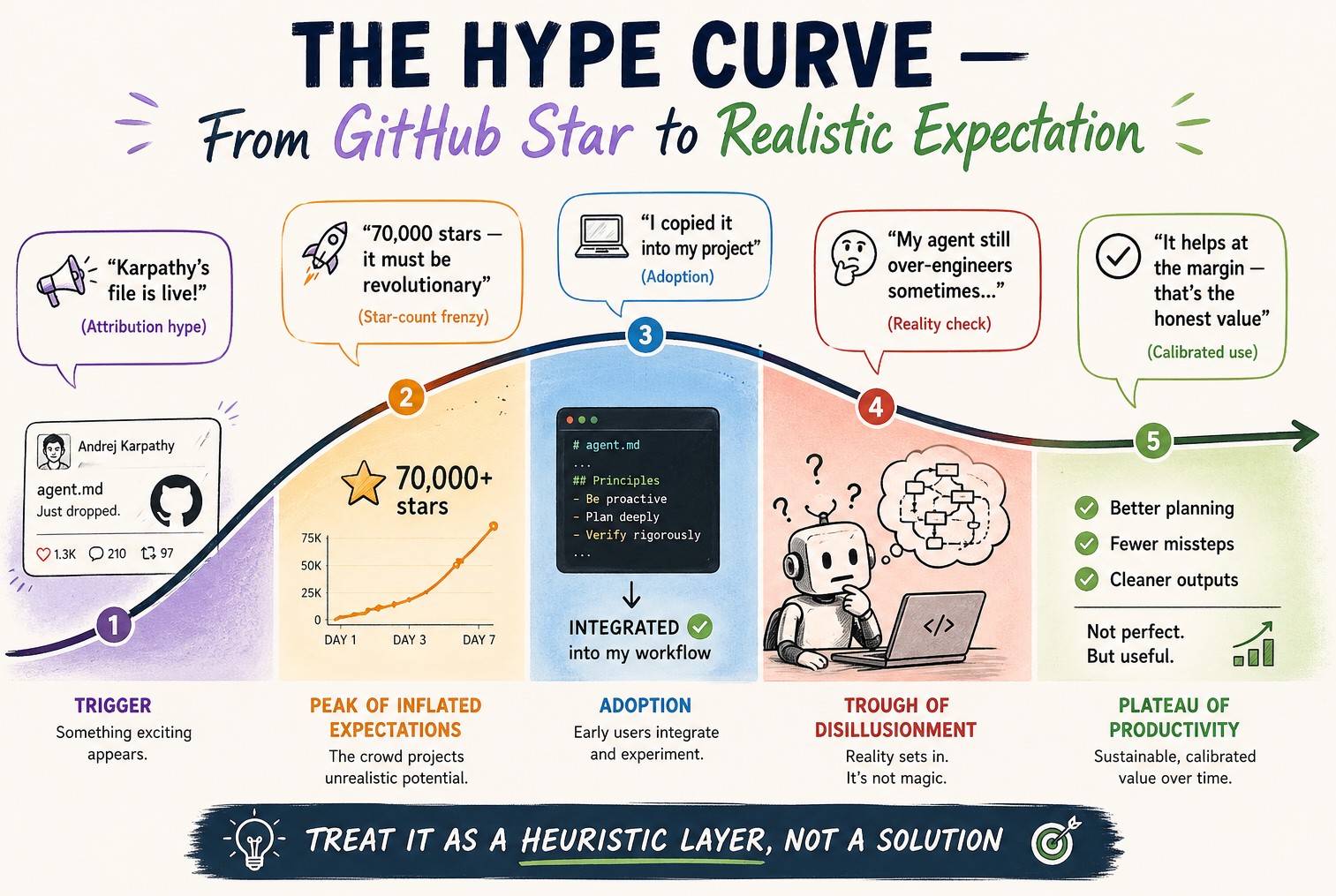
2. What 90,000 Stars Actually Signals
The star count is not evidence of technical sophistication. It’s evidence of widespread frustration. Developers are so fed up with AI agents that over-engineer, make assumptions, and touch files they shouldn’t that a plain-text file with four common sense guidelines gets treated as a breakthrough. The frustration is legitimate. The reaction to this particular file is a proxy for something much bigger.
3. Markdown Files Are Not Reliable Instruction Layers
Claude Code reads claude.md at the start of a session, but whether the model follows every guideline consistently across every task and every session is not guaranteed. LLMs do not follow instructions the way a compiler follows syntax rules. They follow them probabilistically. On a complex, multi-step task, the model can and will drift. You will still get over-engineered outputs. You will still get unsolicited refactors. A text file cannot patch model behavior at the weights level.
4. These Principles Are Not New
Think before coding. Keep it simple. Make surgical changes. Define success criteria. These principles appear in Clean Code (2008), The Pragmatic Programmer, and virtually every serious software engineering onboarding document. Celebrating them as insights in 2026 suggests that many people entering AI-assisted development have skipped the foundational engineering discipline these principles came from.
5. The Real Problem Is Structural, Not Instructional
The reason AI coding agents make assumptions and touch files they shouldn’t isn’t because they’re missing a markdown file. It’s because of how these models are trained, what they’re rewarded for, and how agentic loops are designed. A claude.md file can nudge behavior at the margin. It cannot address root causes. For that, you need better model training, better tool design, and better evaluation frameworks.
Why It’s Still Worth Using — For the Right Reasons
None of the above means you should ignore the file. Here’s why it’s still worth five minutes of your time:
- It’s a ready-made starting point. If you haven’t defined how you want your AI agent to behave, this file does the thinking for you — and the thinking is good.
- It’s portable. Whether you’re using Claude Code, Cursor rules, Copilot instructions, or any other agent configuration layer, the same philosophy applies.
- It’s short. You can read it in two minutes and adapt it in five.
- It acknowledges its own limits. The file itself notes that these guidelines bias toward caution over speed for trivial tasks and encourages judgment. That’s a responsible caveat that the hype usually buries.
If it causes your agent to ask even one more clarifying question before building an architecture you didn’t ask for, it has already saved you real time.
How to Install It
Option 1: Claude Code Marketplace Plugin Open Claude Code, navigate to the Marketplace, and install the plugin directly.
Option 2: Direct Download Into Your Project Copy the download link and run it in your project directory. The claude.md file will be downloaded directly.
Option 3: Append to an Existing Claude.md If you already have a claude.md, use the provided code snippet to append the Karpathy guidelines rather than replace your existing file. This preserves your project-specific instructions.
The same append logic works for agents.md, Copilot instructions.md, or any equivalent config file in your agent setup.
Key Takeaways
- The Claude.md / Karpathy Skills file is one 66-line markdown document with four behavioral guidelines for AI coding agents.
- The four principles — Think Before Coding, Simplicity First, Surgical Changes, Goal-Driven Execution — are genuinely solid engineering advice.
- It is not authored by Andrej Karpathy. The attribution is a marketing framing.
- LLMs follow instructions probabilistically, not deterministically. The file will help at the margin, not solve the problem.
- The structural problems in AI coding agents — training, tool design, eval frameworks — require structural solutions.
- Use the file as a heuristic layer and a useful default. Don’t treat it as a paradigm shift.
- The real lesson is the gap it exposes: reliable AI-assisted development is still an unsolved problem.
Conclusion
The Karpathy Claude Skills repo is worth five minutes of your time. Drop it into your Claude Code setup, read the four principles, and see if they improve your workflow at the margin. They probably will — a little.
But don’t let 70,000 stars convince you that a 66-line text file has solved the hard problems of AI-assisted development. Those problems live at the level of model training, evaluation design, and tooling architecture. They are still very much open.
The most important takeaway from this whole episode isn’t about the file. It’s about the gap the file is trying to fill — and the fact that that gap is still enormous.