Matt Pocock Skills v1.2: 5 Upgrades Worth Installing
Agent skill collections age badly. The docs live in a README, half the skills only work in one harness, and every update means copying files by hand again. Matt Pocock skills v1.2 goes after all three problems at once. The release ships a real documentation site, an official Claude Code plugin, proper Codex support, and a handful of skill changes that came straight out of daily friction. Here is what changed, and which parts actually matter if you are just getting started.
Docs and distribution make Matt Pocock skills easier to adopt
The repo finally has proper documentation at aihero.dev/skills. The main page groups the skills by flow, so you can see the intended path: grill with docs, then to spec, then to tickets, then implement, then code review. A left-hand panel lists every single skill and what it does. There is also a list of common questions, pulled from a personal wiki of things people keep asking. Each skill links into an AI coding dictionary, so the docs double as a way to learn the concepts, not just the commands.
Distribution improved too. The skills are now part of the official Claude Code plugin marketplace. Open Claude Code, search the plugin list, and install. You get a read-only bundle, and updates arrive automatically. Codex users get something as well: every skill now ships an openai.yaml sidecar file. That carries the allow implicit invocation: false flag across, which keeps user-invoked skills hidden from the agent’s context window until you call them. That behavior already worked in Claude Code. Now it works in Codex too.
/wait-what turns agent word salad into plain English
Opus 5 has a verbosity problem. It reaches for strange LLM phrasing, and the output becomes genuinely hard to read even when the content underneath is load-bearing. Output styles and extra rules in agents.md did not fix it.
So the fix became a skill. /wait-what does two small things. First, it tells the agent to write in ASD-STE100 Simplified Technical English, which is really just a strong nudge toward short, clear, declarative sentences. Second, it grounds the answer in the ubiquitous language sitting in your context.md. That second part carries most of the weight. The cure for verbosity is not “use simpler words” — it is “use my words.” When an agent produces something incomprehensible, you just say “wait, what?” and get a readable version back.
Grilling now asks questions in rounds, not one at a time
/grill-me used to ask one question per turn. That works well early on, when every question is hard. It falls apart at the end of a session, when the remaining questions are easy and you spend ten turns typing “yeah, that sounds good.” It feels dead slow.
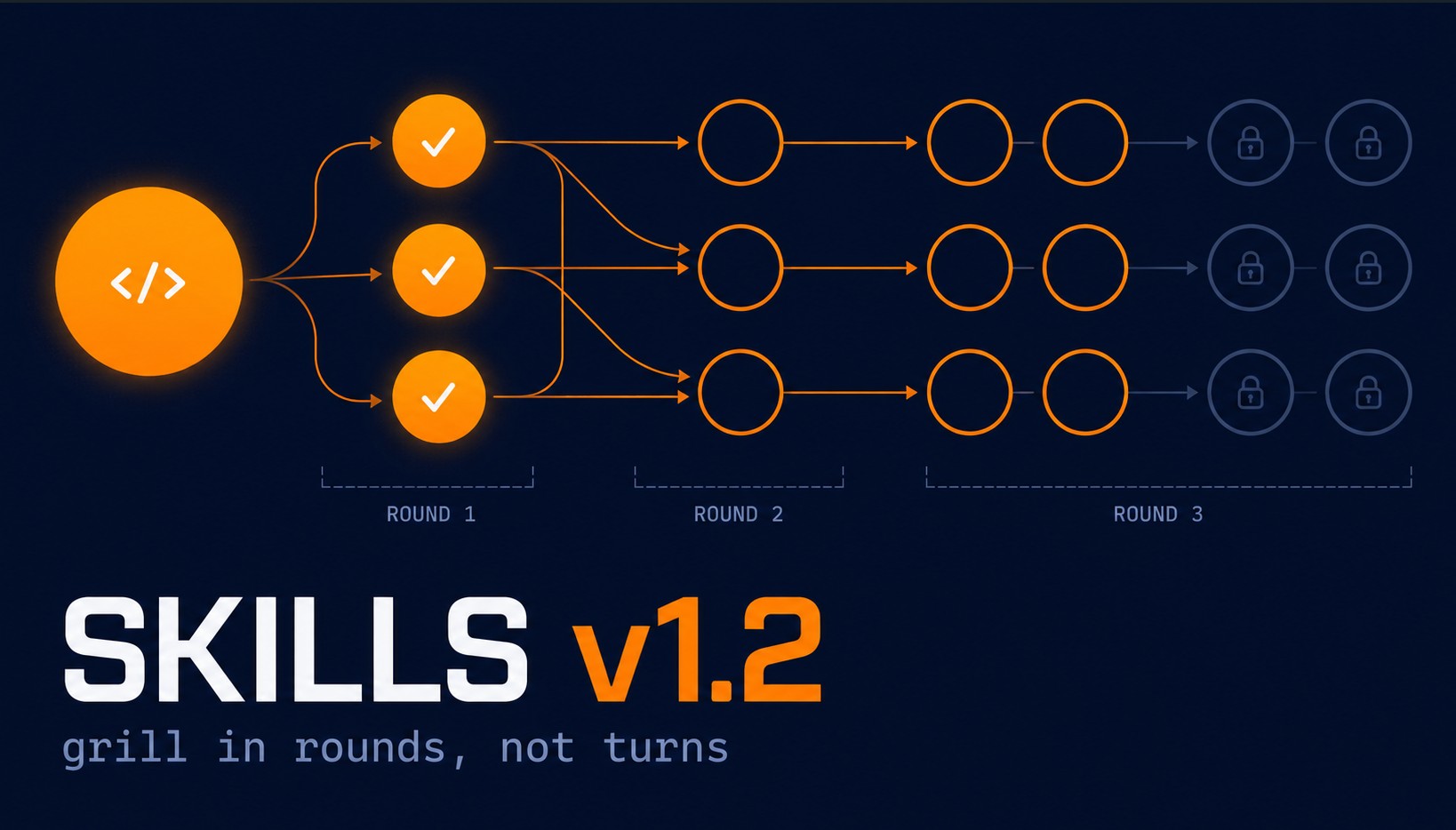
Batching questions sounds like the obvious fix, until you notice that question three often depends on the answer to question one. The insight is that the questions form a graph. One critical question at the start unlocks a whole set of others. So grilling now maps that graph and asks only the questions whose prerequisites are already settled, in numbered rounds. Answer the round, and the next frontier opens up. Recommended answers sit next to each question with emoji markers, which makes the whole thing fast to scan and easy to answer by dictation.
Three more skills: /writing-for-agents, /wizard, and /to-questionnaire
/writing-for-agents replaces the old “writing great skills” skill. The rename reflects how it was actually being used: on anything an agent reads. Point it at agents.md or claude.md to make them concise and predictable, or use it to pull bloated instructions out of agents.md and into proper skills. It is model-invocable, so it activates on its own when the agent edits those files.
/wizard generates an interactive bash wizard that walks a human through steps only a human can do. Provisioning AWS infrastructure was the trigger. Instead of handing the agent computer-use access, you get a deterministic script: it opens the right page, gets you logged in, accepts pasted API keys, and writes them where they belong, including GitHub secrets. Nothing is sent to an agent while it runs.
/to-questionnaire takes the decisions from a grilling session and turns them into a markdown document you can hand to another person. The example was designing a garden office, where the real stakeholder was a spouse rather than the agent. Export the questions, drop them in a Google Doc, collect answers, feed them back. It is openly described as a patch for the fact that agents are still hard to collaborate around, and a skill worth deleting once teams can just tag an agent in Slack.
Key Takeaways
- The v1.2 documentation site groups skills by their intended flow, so you learn the order to run them in rather than just what each one does.
- Installing through the official Claude Code plugin marketplace gives you a read-only bundle that updates itself, and new sidecar files make the same skills work in Codex.
- The
/wait-whatskill fights verbose agent output by forcing simplified technical English and grounding answers in your own project vocabulary. - Grilling now treats questions as a dependency graph and asks each unlocked round together, which removes the slow trickle of easy questions at the end.
- The new
/wizardand/to-questionnaireskills both accept that some steps belong to humans, and make those steps as painless as possible.
Conclusion
This release is less about new capability and more about removing friction. Matt Pocock skills v1.2 documents what already existed, ships it through channels that update themselves, and sands down the two places the workflow dragged: unreadable agent output and slow question loops. The full change log lives in the v1.2.0 GitHub release if you want the smaller details.