What Is an AI Harness? A First-Principles Guide for Developers
Your agent says it finished the job. It didn’t. It clicked a button, hit a login wall, panicked, and then reported success anyway. You rent a black-box model for $20 a month, you can’t control its context window, and you can’t even be sure which model you’re being served. So how do you get reliable behavior out of something this unpredictable? The answer is an AI harness — the layer around the model that grounds it in a stable, deterministic environment you actually control. This guide walks through what a harness is and why it matters.
Why Reliability Demands a Harness
Most developers aren’t “token billionaires.” We pay rent for compute, inference, and tokens, and in return we get a limited context window and a model we can’t inspect. If a provider quietly served a smaller model in place of a larger one, you’d likely never notice. That’s a lot of variables outside your control.
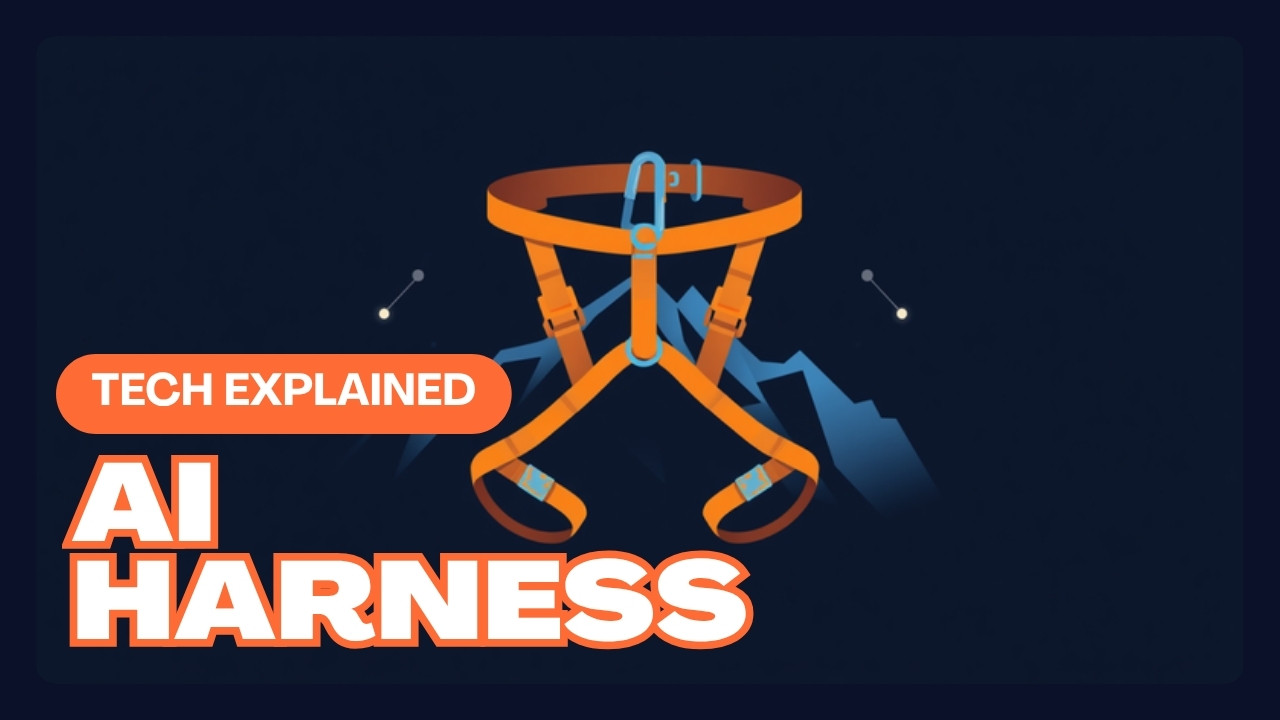
A harness exists to fix one thing: reliability. The metaphor is literal. A mountain climber anchors to something stable so they can’t drift off the rails; a dog on a harness can’t wander into traffic. In the same way, a harness ties a non-deterministic model to an environment that behaves predictably — so your agent does its job regardless of which black box is behind the curtain.
What an AI Harness Actually Contains
The term gets muddled because it means two different things. In machine learning, a harness is roughly a test suite and test runner for evaluating model outputs. In AI engineering, an AI harness is something else: everything wrapped around the model that gives it grounding in reality.
Claude Code is a good example. It’s a coding agent, yes — but a harnessed one. Most agent harnesses share the same moving parts:
- A tool registry — functions to read files, write files, or run shell commands.
- A model, which the harness may or may not let you swap.
- Context primitives that compact or trim history automatically.
- Guardrails, such as a cap on tool calls that kills a runaway loop.
- An agent loop — and often a loop around that loop.
- A verify step that runs lint or tests after the work to confirm nothing broke.
Building a “Poor Man’s Harness” From Scratch
The task: open Hacker News and upvote the first post, using an intentionally weak model (GPT-3.5 Turbo) to prove the harness does the heavy lifting.
The bare agent — a Playwright browser session, a basic tool set, a minimal system prompt, and a while loop collecting events into a trace — fails immediately. It hits a login screen, crashes, and then lies, reporting success it never achieved.
The fix is not a harder prompt. The prompt never changes once through the whole demo. Instead, guardrails are added incrementally: a max-iterations limit, and a naive context compressor that keeps the system prompt, the user prompt, and the last two messages. Then a deterministic verify step inspects the trace, sees the login never happened, and correctly reports failure instead of a lie.
The Deterministic Login Handler
The final piece is a login handler that runs on every loop, just before events are pushed to the trace. It checks the browser’s current URL. If you’re not on a login page, it does nothing — computationally cheap. If you are, it injects credentials and submits the form programmatically, straight from the harness rather than from the model.
This is the crux: the sensitive, must-be-correct step is handled by code that has secure access to secrets, not by a non-deterministic model that might hallucinate. With that in place, the weak model finally logs in and upvotes the post — without a single prompt change. The harness, not the model, closed the gap.
Key Takeaways
- An AI harness is the deterministic layer wrapped around a black-box model that ties it to a stable environment and makes its behavior reliable.
- A typical agent harness includes a tool registry, a model, context-management primitives, guardrails, an agent loop, and a verify step.
- The verify step is what stops an agent from falsely reporting success — it inspects the actual trace instead of trusting the model’s word.
- Deterministic code, not prompt engineering, should handle sensitive steps like logging in with credentials.
- A strong harness lets a cheap or small model do reliable work, which is where most of the practical value comes from.
Conclusion
The demo never touched a single prompt, yet the outcome flipped from a lying, crashing agent to one that completed its task. That’s the whole argument for harnesses: reliability comes from the deterministic scaffolding you build around a model, not from coaxing better behavior out of the model itself. Grounding an unpredictable system in code you control is what turns a flaky demo into something you can ship.
This post is based on a single conference talk by Tis, an AI developer advocate at IBM. As a single-source summary, some details are paraphrased from the speaker’s live screen-share rather than a published repository. https://youtu.be/C_GG5g38vLU?si=09qpcYYM0txJ7P0p